AskERISA™ is a governed AI platform that gives retirement professionals answers they can
defend: every claim traced to its source, every refusal a design decision, not a failure.
Answers you can defend § Every claim traced § Refusal by design § Section-level citations § Version-aware retrieval §Answers you can defend § Every claim traced § Refusal by design § Section-level citations § Version-aware retrieval §
§ 01 Context & Stakes
A wrong answer here isn't just a bad review.
Fiduciary ExposureFailed AuditsCompliance FindingsBad Guidance to Sponsors
Whether acting on their own behalf or someone else's, AskERISA™ is built for people who
answer, decide, and defend. A confident guess becomes fiduciary exposure, a failed audit,
or a compliance finding, so the product has to know when to clarify, refuse, or escalate.
The regulation
EOB, IRS/DOL guidance
AskERISA™
Citations, not guesses
The person decides
The user, not the app
What's on the line
Fiduciary & audit risk
§ 02 Where It Sits
Nobody else owns interpretation.
Broad platforms like Lexis+ AI have decades of trust but aren't ERISA-native. Narrow ERISA
search tools find documents but stop before interpretation. The opening was never speed or
price. It was turning ARA's own authority, the ERISA Outline Book, into a governed AI
layer neither competitor could credibly copy.
Where the gap sits
Broad Legal AI
ERISA Search
AskERISA™
ERISA-native interpretation
General
Retrieval only
Purpose-built
Citation & version governance
Broad
None
Section-level
Refuses when evidence is weak
Sometimes
N/A
By design
Inspectable audit trail
Not exposed
Not exposed
Full console
From a reference you search to answers you can verify.
The ERISA Outline Book is the authority practitioners already rely on. AskERISA™ keeps that
source and takes the manual work out of it for the TPAs, consultants, and advisors who cannot
afford to guess, at $290 less a year.
ERISA Outline Book$950/yr
40,000
Source material links, navigated by hand
SearchQuery the index and hope the terms match how the outline is written.
ReadOpen section after section, since one question often spans several.
TraceFollow cross-references out to the statute and to DOL and IRS guidance.
InterpretWork out how the rules apply to the client in front of you.
RecordBookmark, copy, or print, because the finding lives nowhere else.
AskERISA™$660/yr
Seconds
Not hours, from question to cited answer
AskType the question in plain English, the way you would ask a colleague.
ReviewReceive a direct answer with its citations grouped by EOB chapter and section.
VerifyOpen any citation at the exact passage and confirm it before relying on it.
Admin oversightEvery query is logged with its answer and sources for a defensible record, and source material is updated as rules change.
§ 03 Product Thesis
Trust isn't a label. It's a behavior.
01
Trust had to be designed, not implied.
02
Familiarity was not enough without control.
03
Visibility is what made the product believable.
§ 04 Scope Of Work
The system behind the sentence.
The visible product is a chat window. The real design problem was the machinery that had
to exist before that window could be trusted with a fiduciary question: a system that
worked end to end, from competitive framing to the governance console.
Research
Trust Behaviors
The Split Decision
The Handoff
◎
Research
Stakeholder interviews with ARA, a competitive audit, and mapping who actually carries the risk of a wrong answer.
Interviews with ARA surfaced who actually carries the risk: advisors, TPAs, actuaries, attorneys, compliance officers, not the end employee. The competitive audit found the real "before" wasn't Lexis+ AI. It was ARA's own ERISA Outline Book, a $950/year, 40,000-link reference you had to search yourself. One demographic detail reset every interface decision after this: a meaningful share of subscribers are 65 to 90.
◆
Trust Behaviors
Turned "trust" into system behaviors: citation gating, refusal-over-guessing, version-aware retrieval.
Citation gating means no answer ships without a source attached. It's a hard gate in the pipeline, not a formatting choice. Refusal-over-guessing means low-confidence or conflicting queries get pulled into human review instead of answered anyway, about 6.3% of real traffic. Version-aware retrieval means the system knows which year's guidance applies. None of it is copy on a page. It's stages a bad answer can't get past.
✦
The Split Decision
A dense, enterprise interface would have signaled rigor, and lost the subscriber who just wants to type a question.
Two concepts were tested side by side. One leaned enterprise: dense information architecture, visible controls, dashboard-like structure, the kind of interface that promises rigor on a sales call. The other was a plain chat window. Enterprise UI would have looked more serious and been unusable to a 70-year-old subscriber. The resolution wasn't a compromise. It was a split: keep the surface as simple as the chat products people already know, and move the rigor into a console most users will never open.
▤
The Handoff
Four systems that only work as one. Pull any piece out and the trust claim breaks with it.
Persona-driven views change what an advisor sees versus an actuary, from the same answer. The query debugger reconstructs why the system answered the way it did, stage by stage. Pipeline routing decides how much scrutiny a question gets before persona or debugger come into play. The console is where all three become visible to someone who didn't write the code. Pull the debugger out and routing becomes unverifiable. Pull routing out and the debugger has nothing consistent to reconstruct.
§ 05 The Web App
Watch it work, end to end.
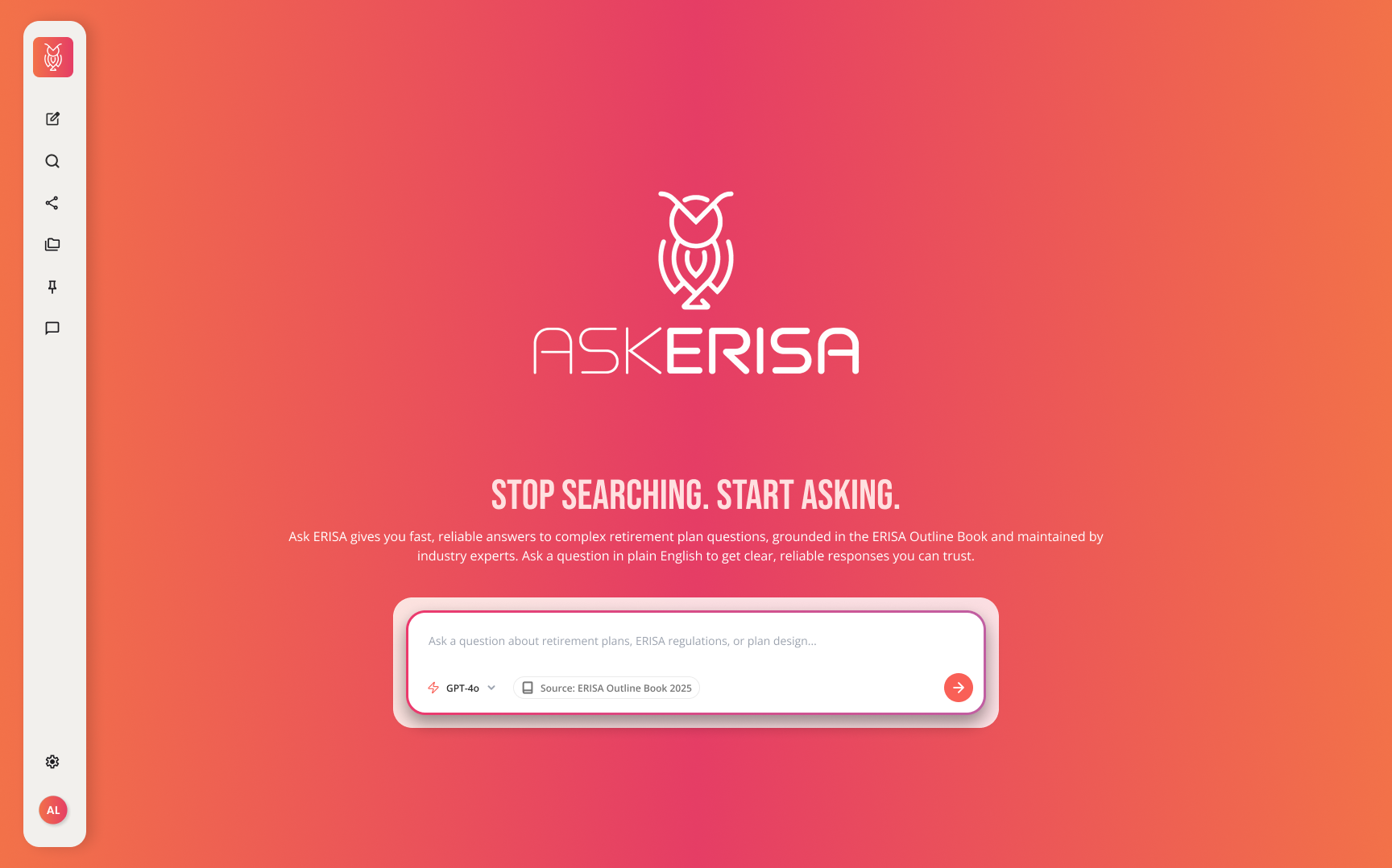
One continuous pass through the product, narrated: asking a question, reading sources, working across folders, sharing for review. The client's own walkthrough, not a highlight reel.
askerisa.com
FULL WALKTHROUGH — narrated, 2:40WEB APP
Familiar on the surface. Governed underneath.
A meaningful share of AskERISA™'s subscribers are 65–90. They didn't come here to learn a new tool. Type a question, read an answer: the interface asks nothing new of them. What's running behind it does.
askerisa.com
Every claim, traced.
The exact ERISA Outline Book chapter, section, and part sit behind every answer. The citation isn't a footnote, it's inspectable.
CHAT — one continuous take, question to citationWEB APP
Built for review.
Read-only share links let a supervisor or compliance officer watch the reasoning — not just the result — with authorship kept clean.
askerisa.com/share/chat1r1r
One conversation is easy. Two hundred is a caseload.
Folders give conversations structure by plan, client, or topic, while All Chats adds the controls needed at scale, including search, rename, move, and bulk delete. Together, they turn a simple chat log into a workspace built for real caseload volume.
askerisa.com/conversations
FOLDERS — create, file, then search across every conversationWEB APP · ALL CHATS & FOLDERS
§ 06 Practitioner Reviews
Practitioner verdicts.
Before launch, retirement professionals put AskERISA™ to work on their actual caseloads. Here’s what they told ARA. Read the source (opens in a new tab)
Mergers & acquisitions
“Was able to ask some questions today (specifically around mergers and acquisitions) and wow! I'm seriously impressed.”
CPCPAPractitioner feedback
Complex questions
“I ran a pretty difficult question through and am impressed with the result. […] My answer was step-by-step and exactly what I expected.”
SCSenior Manager of Consulting ServicesPractitioner feedback · Excerpt
Ease of use
“I thought the system worked well and was easy to understand and use. The responses were accurate and conveyed in an accessible and informative way.”
VPVP, Business DevelopmentPractitioner feedback
Client conversations
“I've used it to ask questions that clients have because sometimes I am overly technical, and the language it provides is more easily understandable. I particularly liked the answer it provided for the 31% deduction limit.”
RCRetirement Plan ConsultantPractitioner feedback
Accuracy & response time
“I was able to utilize it today and I was pleasantly satisfied with the accuracy and response time provided.”
RCRetirement Plan ConsultantPractitioner feedback
Review 1 of 5
§ 07 Command Center
Turning "trust me" into "watch."
AskERISA™ can't out-history LexisNexis on day one. So the admin console does the
persuading: every query inspectable, every citation conflict surfaced, every escalation
logged, and every persona configured from one place.

The first screen an administrator sees tracks risk posture, not vanity metrics. Queries processed, citation coverage, average confidence, refusal rate and cost per query sit next to a live feed of priority risks, such as escalations awaiting human review and conflicts between sources.
admin.askerisa.com/dashboard
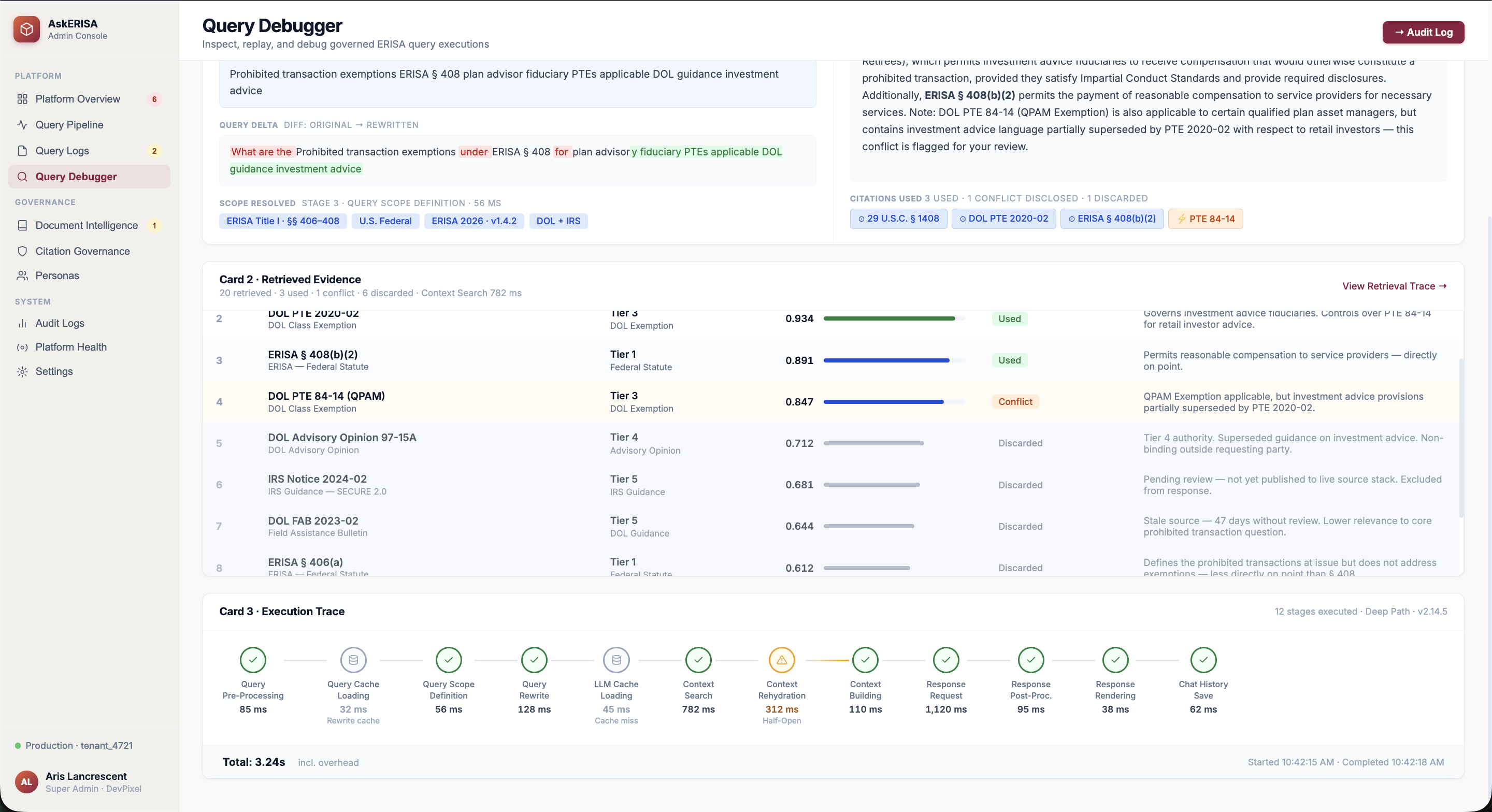
When someone asks why AskERISA™ answered the way it did, the debugger reconstructs it stage by stage: the question as asked and as rewritten, the evidence ranked and marked as used, conflicting or discarded, and the execution trace behind the final answer.
admin.askerisa.com/query-debugger
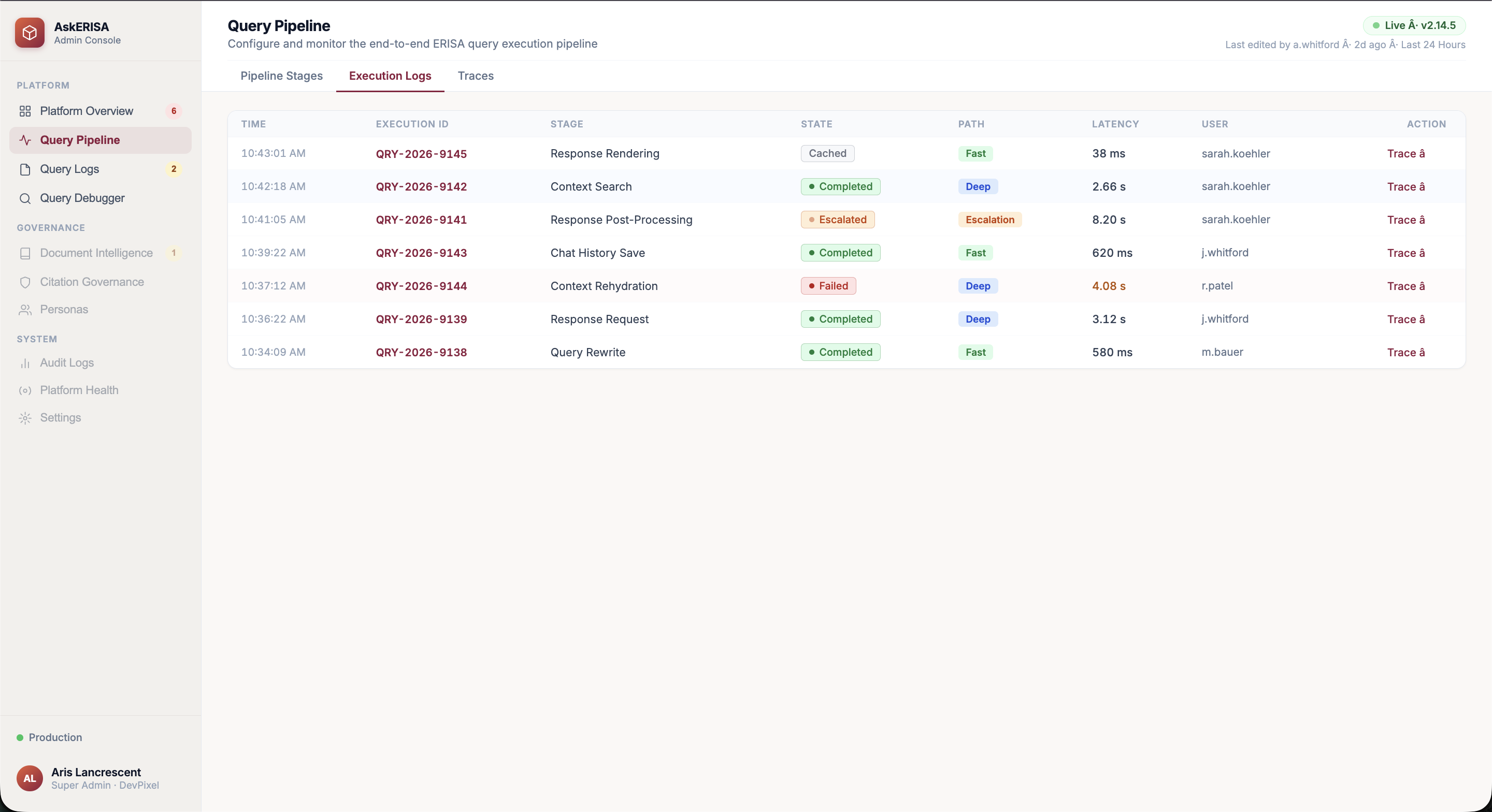
Every stage of the pipeline reports its own health, latency and error rate. Execution traces show real runs with failures included, so a problem is traced to the exact stage where it happened instead of being hidden behind an average.
admin.askerisa.com/pipeline
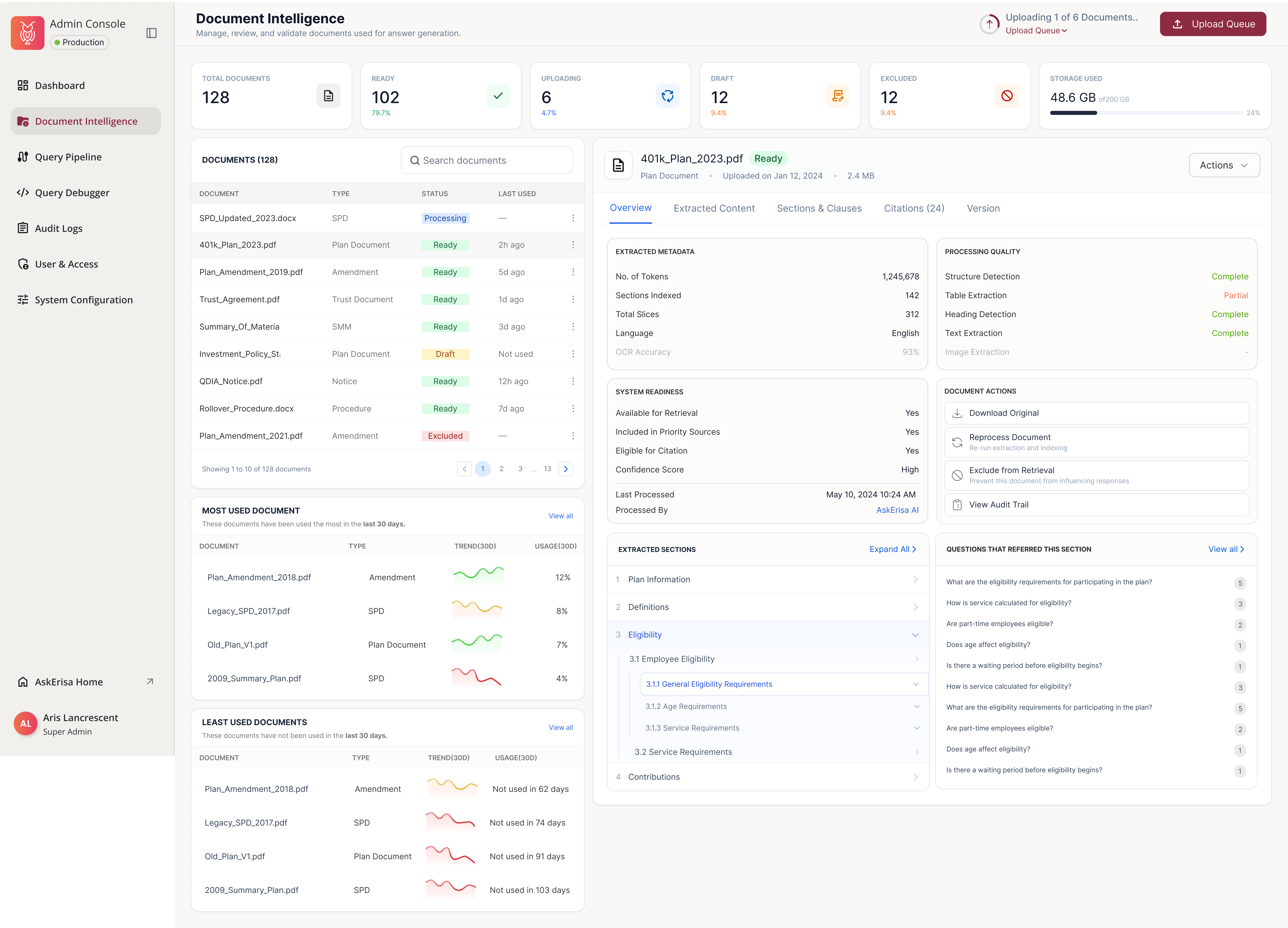
Every source is split into sections, versioned and scored for processing quality before it can be cited. This is also where new guidance is uploaded when the rules change, so answers always draw on the version in force.
admin.askerisa.com/documents
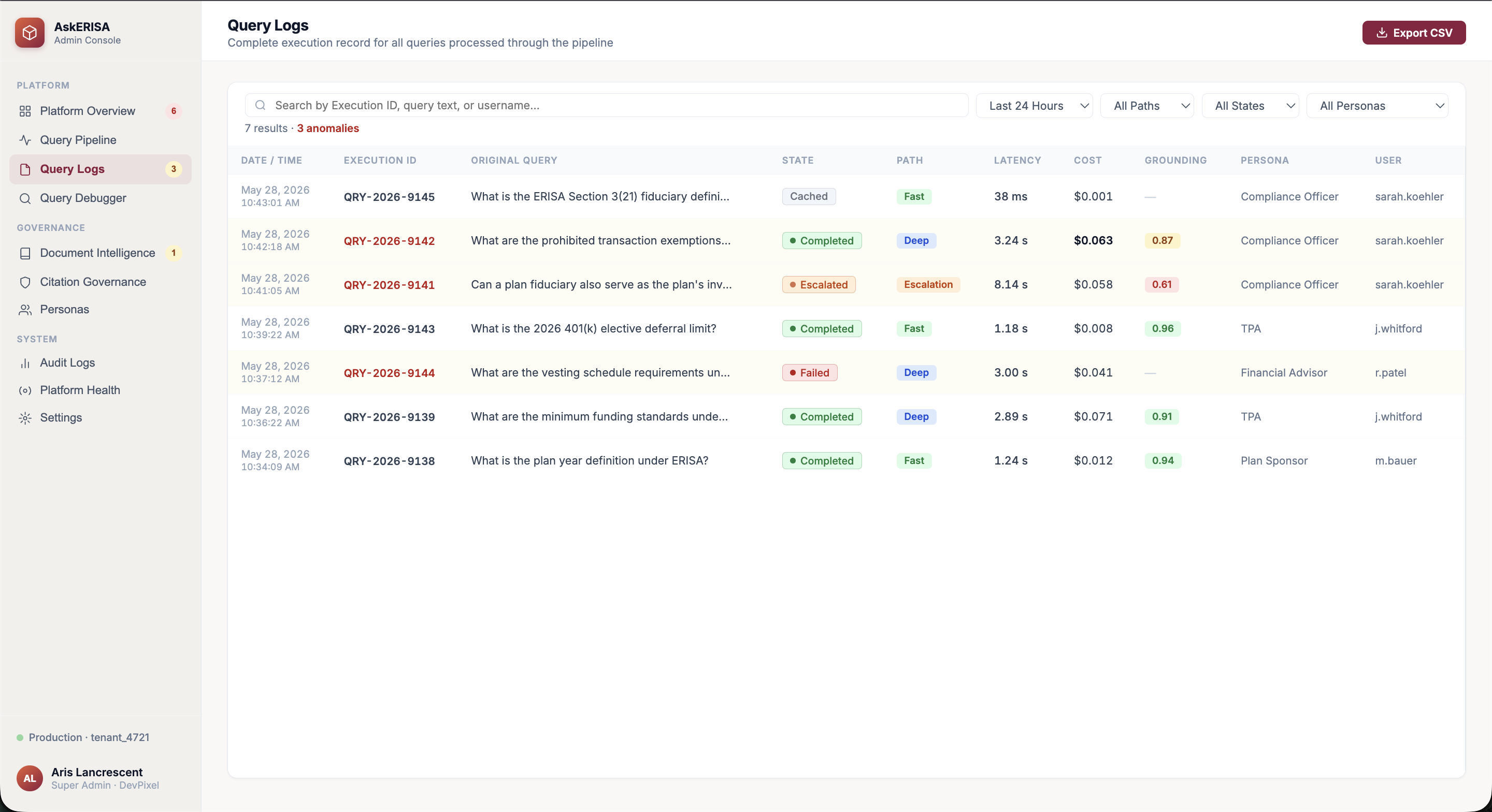
Every query that has ever run is on the record, filterable by persona, execution path and confidence. The routing split in the next section is not a claim. It is this table.
admin.askerisa.com/query-logs
Seven reader profiles, from advisor to actuary to individual subscriber, each tied to a subscription plan and its usage limits. One screen sets the response length, level of detail, minimum citations and language for each.
Before AskERISA™ answers, it sorts each question by how complex it is and how well the
sources support an answer. A simple lookup with one clear source is answered right away.
A question that needs several sources read together gets extra checks first. And when the
sources are weak or disagree, the system doesn't guess: the question goes to a human reviewer.
None of this happens out of sight. Every query in the logs carries its path and confidence
score, and every escalation waits on the dashboard until someone reviews it.
Fast Path
64.3%
"What's the 2026 contribution limit?"Single-source, high-confidence, answered in about a second.
Deep Path
29.4%
"Does this vesting schedule comply with SECURE 2.0?"Multi-source, cross-regulatory reasoning, stricter validation.
Escalation
6.3%
Low confidence or conflicting sources get routed to a human reviewer instead of being answered automatically.
§ 09 On The Go
Same answer, pocket-sized.
ERISA questions come up between meetings, not just at a desk. The app keeps your conversations and sources in sync with the web, carrying the same patterns throughout, so a chat started on a laptop picks up right where it left off on a phone.
Mobile walkthrough
§ 10 Visual Identity
The all-knowing owl, client-supplied.
The owl is the all-knowing reader: it has read every book, so you don't have to. This page
already speaks AskERISA™'s native language. The gradients, the Bebas headlines, the tagline
itself are the brand's own. Here's the kit as delivered.
Stop Searching. Start Asking.
Stop Searching. Start Asking.
Stop Searching. Start Asking.
Stop Searching. Start Asking.
#F37448
#ED3869
#78BE40
#F1D205
#8C2B42
#EC396C
#C15EA2
#F37448 → #EC396C
#78BE40 → #F1D205
#ED3869 → #C15EA2
Bebas
Big Titles & Taglines
Reserved for headlines, ads, and anywhere the brand raises its
voice, including every headline on this page.
Open Sans
Presentation & Online Content
The body face for
everything else: friendly, professional, and available everywhere the product runs.
§ 11 Future Scope
The first rulebook. Not the last.
Nothing in the trust layer actually knows it's ERISA. Swap the Outline Book for a tax
code, a clinical protocol library, an insurance underwriting manual. The same console
ingests it, slices it, cites it, governs it. One backend. Any authoritative source.

.png)